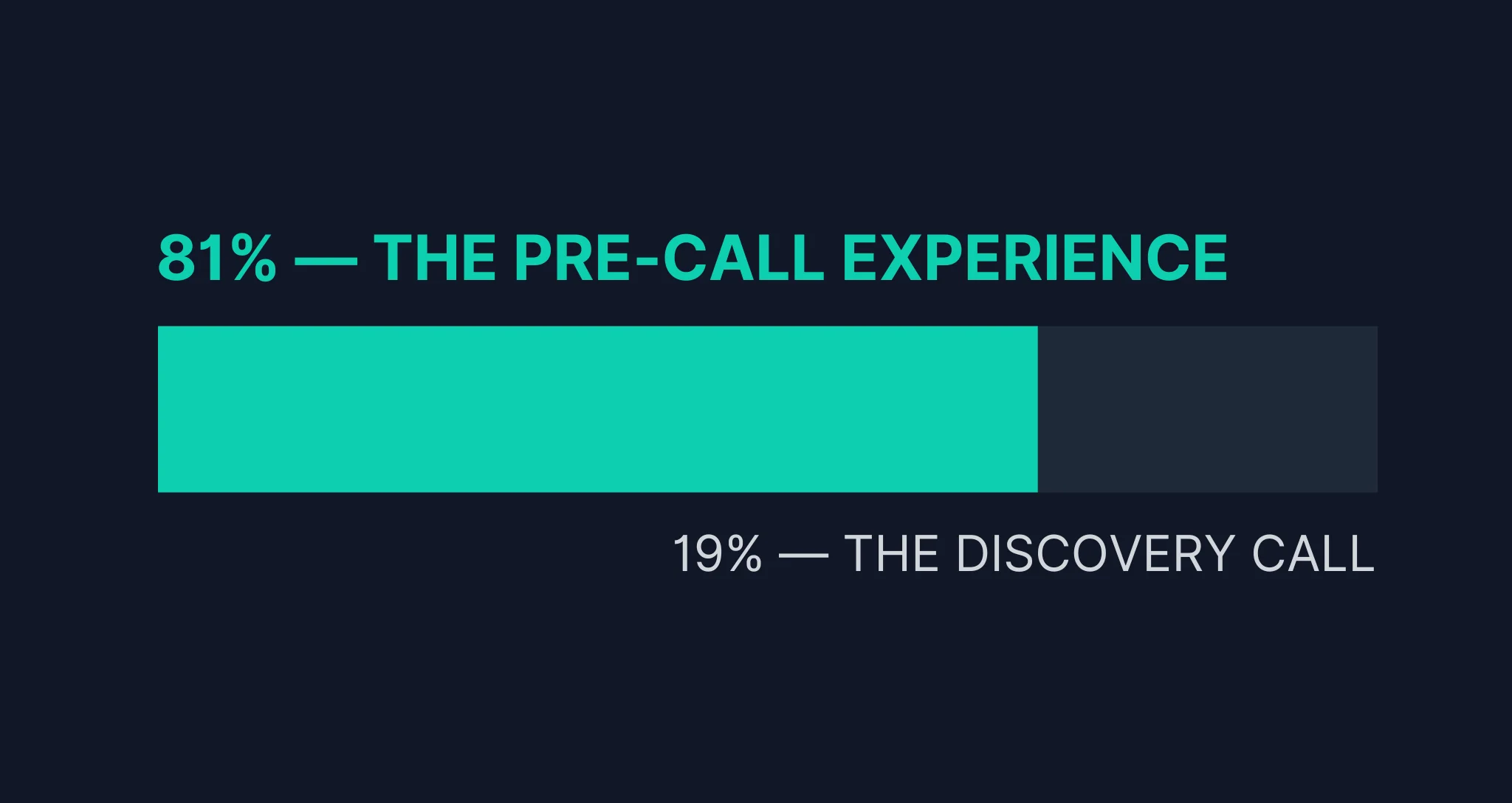
By the time someone books a call with you, most of the decision is already made. Research puts it at 81%. It didn't happen on the call. It happened before it. The website they visited. The post they stopped on. The reply they got after reaching out. That's where clients are won or lost. Most businesses never look there.
Somewhere between the ad they clicked and the call they booked, your next client is making up their mind.
Not on the call. Before it. While reading your services page at 10pm, or landing on your portfolio after a referral, or waiting to see how quickly — and what — you send back after they fill out your contact form.
By the time the call happens, most of that decision is already in place.
Research from Dreamdata and LinkedIn puts it at 81%. The call — the part most business owners work hardest on — shapes the other 19%. A separate 6sense study of more than 4,000 buyers found that 94% already have a preferred vendor in mind before they ever make contact, and they go on to choose that early favourite 77% of the time. The preference forms before anyone picks up the phone.
Most business owners put their energy into being impressive on the call. The questions they'll ask, how they'll present their work, the follow-up email they send after. That makes sense — it's the part you can see. But the part that determines who shows up, and how decided they already are, happens somewhere else entirely.
You don't start the sale on the call. You inherit whatever the person already decided before they dialled.
When they've already decided before they call
When the work before the call is done properly, you can feel it the moment they show up.
The person isn't cautious. They're not still shopping around. They've read enough to know they want to talk to you specifically. Something they found described their situation closely enough that the comparison stopped. The page they landed on wasn't talking to every business owner in their industry. It was talking about the specific problem they'd been sitting with.
By the time they reach out, the trust question is settled. The relevance question is settled. The "do I want to work with this person" question is largely settled.
What's left is the actual conversation. Their situation. Your approach. Whether it makes sense to move forward.
That's a completely different call. Not better sales technique. Just less ground to cover because the groundwork was already laid.
Where people form their opinion of you
It happens across the same places every business already has. Most just weren't built with a specific person in mind.
Think about what brought them to you. An ad, a post, a search result. Does the message that made them click match what they find when they get there?
A commercial attorney running an ad about protecting business owners during a partnership dispute, whose homepage talks about "full-service legal solutions for individuals and businesses," has already lost that person. They clicked because something spoke directly to their situation. What they found when they arrived could have been anyone.
Then there's the headline on your landing page. Does it describe a situation the person reading it is actually in? Or does it name a service category and leave them to figure out if it applies to them? A financial advisor whose page opens with "comprehensive wealth management solutions" is talking about themselves. One whose page opens with "you've built something meaningful — now the question is how to protect it" is talking to someone. One of those stops the scroll. The other doesn't.
Then your services page. Does it open with what the client is dealing with, or jump straight to credentials and a list of deliverables? People aren't there to read a brochure. They're trying to figure out if you understand their situation.
Then a LinkedIn post. Does it say something only you would say, something that makes the right person think "this person gets it"? Or could it have come from anyone in your space?
Each of these is a quiet moment where someone is deciding whether to keep going. None of it requires a phone call. All of it shapes the call when it finally happens.
The gap that never shows up in your numbers
Most business owners don't think of their website and follow-up as something that needs to be built carefully. It's just the website. The contact form. The LinkedIn profile. Stuff that got set up at some point and hasn't really been looked at since.
A website built when the business launched. A services page that lists what's on offer. A contact form at the bottom. A LinkedIn profile with experience and credentials. Each piece exists. None of them were built to work together.
The result is that people fall off quietly at every step.
Someone searches for help with a specific problem. Your ad speaks directly to it, they click. They land on your homepage: a generic headline, a list of services, nothing that signals you understand the specific situation that made them click. The thing that caught their attention is gone.
They scroll. Your services page lists what you do. Your about page lists your background. Nothing tells them you've worked with people in their exact situation and know what to do about it.
Some fill out the contact form anyway, because the credentials look solid. The response comes back: "Thanks for reaching out. We'll be in touch within 24 hours." Whatever brought them there is gone.
There was no single mistake. But from the ad to the landing page to the contact form response, nothing gave them a clear reason to keep going.
This often gets read as a sales problem. A business owner whose calls convert well enough, who follows up carefully, who has refined how they present their work — but too many calls start with someone who still hasn't decided. Still comparing. Still not sure.
That gap opened before they ever reached you.
The easy ones may have dropped off before they ever got to you. The ones who did reach out arrived with less certainty than they should have, because nothing they found gave them a clear reason to believe you were the right fit.
You can't see this in your call numbers. Your call data only knows about the people who made it to the call. It has no record of everyone who spent time on your page, couldn't find a clear signal that you understood their situation, and moved on without reaching out.
That's invisible. And because it is, most businesses never fix it.
What this looks like in practice
The difference between a website left to chance and one built deliberately is easiest to see in a business in the middle of making the change.
Case Study — Branding Studio, B2B Repositioning
A branding studio came to us with a problem they couldn't quite name.
The work was strong. Their portfolio showed it. They'd built identities for consumer brands, retail clients, hospitality groups, the kind of work that looks impressive in a PDF and holds up in person. Enquiries came in. But they were inconsistent, unpredictable, and often the wrong fit. Businesses with small budgets. Founders wanting a logo, not a brand. Projects that looked promising at first contact and quietly unravelled once scope was discussed.
The owner's instinct was that they needed better marketing. More visibility. A stronger social presence.
What they actually needed was a clearer answer to one question: who, specifically, is this for?
The studio had never built its positioning around B2B clients. Not because they didn't want to serve them — they'd done excellent work for several — but because nothing in their digital presence said so. The website spoke to everyone. The portfolio was organised by visual style, not by industry or client type. The copy described what they made — logos, guidelines, visual systems — rather than what those things produced for a business that needed them.
A B2B buyer — a marketing director, an operations head, a founder trying to move into bigger deals — landing on that site had no obvious signal that this studio had worked with businesses like theirs, understood what was at stake, or had a point of view on what brand does beyond the aesthetic layer.
So they moved on.
We started with positioning. Not the website. The thinking behind it. Who the studio was credibly able to serve at the highest level, what those clients were trying to accomplish, and what the studio's perspective was on the work beyond the craft itself. From that, a clear profile emerged: scaling B2B service businesses that had outgrown their visual identity and needed their brand to carry weight in rooms where decisions were being made.
But there was a second problem underneath the first.
Even when the studio did reach the right client, the sales conversation happened on the wrong terms. They were presenting branding as a creative service. The prospective client was sitting across from them thinking about revenue, pipeline, and whether this investment made commercial sense. Nobody in the room had connected those two things explicitly.
Most creative businesses never close this gap, because the language that would close it usually comes from a different kind of person. Someone who understands how a visual identity affects pricing power, how brand consistency affects trust at the decision stage, how the thing a branding studio builds is ultimately something that earns money — not just something that looks good.
We helped the studio develop that framing. Not as a pitch. As a genuine point of view on the work they were already doing. What it means when a B2B company's visual identity doesn't match the quality of their offer. How that gap quietly costs them at the evaluation stage, when a potential client is comparing options and surface signals carry more weight than they should. How brand, done properly, is what makes a higher price defensible.
Talking about their work that way changed what they attracted.
The website was rebuilt around the B2B client. The headline spoke to their situation. The portfolio was reorganised to lead with commercial work. The services page opened with the problem those clients were trying to solve. Not a list of deliverables. The enquiry response was rewritten to immediately signal that the right message had reached the right place.
Within three months, the nature of the enquiries had changed. Not dramatically more. Consistently different. B2B clients, appropriate budgets, clearer briefs. Calls that started with people who already understood the value of what they were enquiring about, because everything they'd encountered before the call had been built to speak to them specifically.
The studio hadn't changed what it did. It had changed who it was clearly doing it for, and learned to talk about its own work in the language that audience actually uses to make decisions.
That's what a deliberately built website and process produces. Not better-looking pages. A clearer signal, reaching the right person, before a single conversation has taken place.
Four places where people make up their mind
The path a potential client takes before reaching out runs through four places. A gap in any one of them creates problems that show up later — usually on the call.
The first is whether your offer speaks to someone specific. Not in general. For a particular person with a particular situation. If that isn't visible in what you've built, the right people won't recognise themselves in it. No amount of strong copy repairs a positioning problem. The wrong enquiries arrive. The right ones scroll past without reaching out.
The second is what they actually read when they arrive. Most businesses write from their own perspective — what they offer, how long they've been doing it, what the process looks like. But the person reading doesn't start there. They start with their own situation: does this apply to me, and do these people understand what I'm dealing with? If that answer isn't obvious in the first few seconds, the page has already lost them.
The fourth is what happens when someone does reach out. A filled contact form is the clearest signal of interest a potential client will give you. What comes back — how quickly, in what tone, whether it matches the energy of someone who just raised their hand — determines whether the call happens or quietly doesn't.
What happens when all of it works together
When everything a potential client sees before reaching out — the ad, the page, the copy, the reply to their enquiry — is all speaking to the same person and the same situation, the calls you have become noticeably different.
The people it's built for recognise themselves in it and reach out. The ones it's not built for can tell that quickly and don't. The calls that do happen start further along. Less time on the basics, more time on the actual decision.
The reverse is also true. When your pages describe a service category instead of a specific situation, the people who reach out are still comparing. The call has to establish relevance, build credibility, create the recognition that should have happened before they ever contacted you. Every call that starts that way takes longer and is less certain.
The right question isn't how to close better on the call. It's what the person already thinks of you before the call starts. And whether your website is building that — or leaving it to someone else in your space.
Frequently asked questions
Research from Dreamdata, LinkedIn, and 6sense shows that most of a buyer's decision — whether to shortlist you, whether to trust you, whether you're relevant to their situation — happens through what they see online before they ever contact you. The ad they saw, the page they landed on, the copy they read, the reply they got after reaching out. By the time the call happens, the process that leads to a decision has already run most of its course. The call inherits whatever that earlier experience built.
Start with the page people land on. Ads bring people there, and follow-up picks up from where the page left off. But if the page doesn't carry through what the ad promised, everything around it is working against a gap you created in the middle. Get the page right first. Then look at whether your response to an enquiry actually matches the intent of the person who just reached out.
Yes, often more so. A referred client still looks you up before reaching out. They check your website, read your content, and decide whether what they find matches what they heard about you. If it doesn't, that gap creates doubt before the conversation even starts. Referrals lower the barrier to contact. They don't remove the need for a website that backs up what was said about you.
Depends on how much traffic you're already getting. If you have consistent volume from ads, search, or referrals, a clearer website and better follow-up can change the quality of your enquiries within weeks. If volume is low, the improvement is there — but the signal takes longer to build up. The first thing that tends to change is the quality of the conversations, not the number of them. Better calls before more calls.
At its core: a clearly defined offer, a website or landing page built around a specific type of client and their situation, a follow-up process that responds to what someone signalled by reaching out, and — where relevant — traffic through ads or content. It's not a set of tools. It's the structure that connects those pieces so a potential client moves from first contact to discovery call without losing momentum along the way.
Sean works with service businesses across South Africa and Brazil to build integrated client-acquisition systems — connecting positioning, digital infrastructure, and campaigns into one cohesive structure. The goal is always the same: a system where the right clients arrive already convinced, and the discovery call becomes a conversation rather than a pitch.
That perspective comes from a broad commercial background spanning renewable energy, telecommunications, and automotive — across corporate, franchise, and small business environments in strategic, cross-functional, and client-facing roles.
If you're not sure whether your website and follow-up process are helping or hurting, a discovery call is a free place to find out.